


If you work in the construction industry as a subcontractor, you may have heard of Gross Payment Status (GPS) under the Construction Industry Scheme (CIS).
Gross Payment Status allows subcontractors to receive payments from contractors without CIS tax deductions being taken before they are paid. For many construction businesses, this can improve cash flow and provide greater control over how tax is managed throughout the year.
However, Gross Payment Status also comes with additional responsibilities, and not every subcontractor will qualify automatically.
In this guide, we’ll explain what Gross Payment Status means, how it works under CIS, who can apply, how the application process works, and the key benefits and responsibilities that come with it.
What is Gross Payment Status?
Gross Payment Status is a type of payment arrangement within the Construction Industry Scheme (CIS) that allows subcontractors to receive payments in full without tax deductions being taken by contractors first.
Under normal CIS rules, contractors are required to deduct tax from subcontractor payments before passing the money on to HMRC. Gross Payment Status changes this process by allowing approved subcontractors to receive the full payment directly and manage their own tax payments separately.
For many subcontractors, this can help improve cash flow and make it easier to manage working capital throughout the year.
How CIS deductions normally work
Under the Construction Industry Scheme, contractors must usually deduct tax from subcontractor payments before they are paid.
The standard CIS deduction rates are:
- 20% for registered subcontractors
- 30% for subcontractors who are not registered for CIS
These deductions are sent directly to HMRC and count towards the subcontractor’s tax and National Insurance liabilities.
This means subcontractors often receive less cash upfront, even though the deductions may later reduce their overall tax bill.
How Gross Payment Status changes this
If a subcontractor is approved for Gross Payment Status, contractors can pay them in full without making CIS deductions first.
Instead of tax being deducted at source, the subcontractor becomes responsible for managing and paying their own tax liabilities through:
- Self Assessment
- Corporation Tax (for limited companies)
- PAYE and VAT obligations where applicable
Gross Payment Status is not a way of avoiding tax, and it does not reduce the amount of tax owed. It simply changes how and when tax is paid.
Who can apply for Gross Payment Status?
Gross Payment Status is available to different types of construction businesses operating under the Construction Industry Scheme (CIS).
To qualify, businesses must meet specific rules set by HM Revenue & Customs relating to the type of work carried out, turnover levels, and tax compliance history.
Sole traders
Sole traders working in construction can apply for Gross Payment Status if they meet HMRC’s eligibility requirements.
This is common for self-employed subcontractors who want to improve cash flow and avoid CIS deductions being taken from payments throughout the year.
Partnerships
Business partnerships operating within the construction industry can also apply for Gross Payment Status.
HMRC will usually assess both the partnership itself and the individual partners when reviewing eligibility.
Limited companies
Limited companies carrying out construction work can apply for Gross Payment Status through CIS.
For many growing construction businesses, Gross Payment Status can help improve working capital by allowing payments to be received in full rather than after CIS deductions.
HMRC eligibility requirements
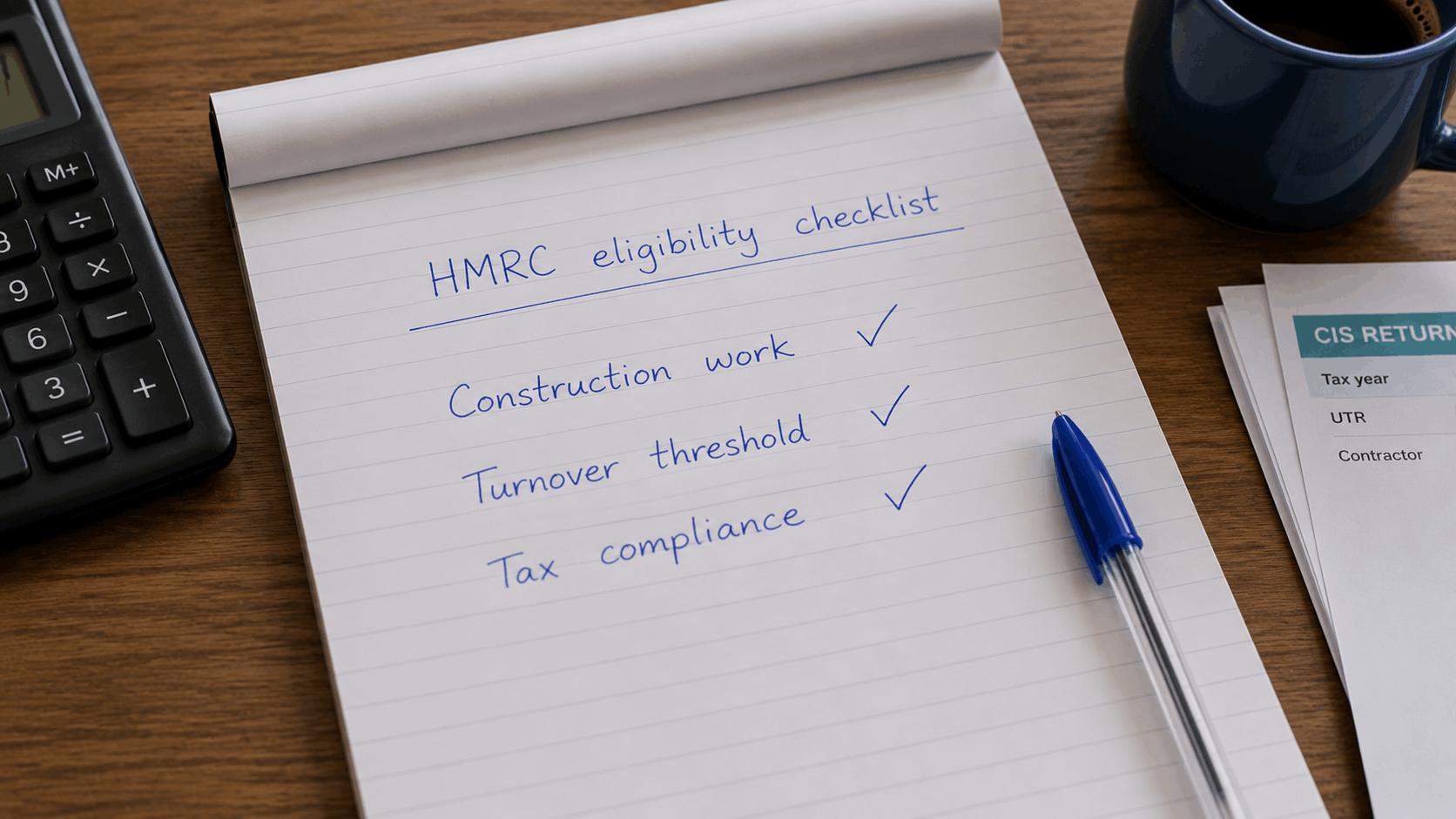
To approve Gross Payment Status, HMRC uses three main tests.
The business test
Your business must carry out construction work covered by the Construction Industry Scheme.
This includes many types of construction, building, and subcontracting work carried out in the UK construction sector.
The turnover test
Your business must meet minimum turnover requirements set by HMRC.
At the time of writing, the general thresholds are:
- Sole traders: at least £30,000 turnover per year
- Partnerships: at least £30,000 per partner
- Limited companies: at least £30,000 per director or £100,000 total turnover
HMRC reviews turnover to ensure the business is operating at a sufficient commercial level.
The compliance test
HMRC will also review the business’s tax compliance history before approving Gross Payment Status.
This includes checking that:
- Tax returns have been submitted on time
- PAYE and VAT obligations are up to date
- Tax payments have been made correctly
- There are no significant compliance issues or outstanding problems with HMRC
Consistent compliance is one of the most important parts of both obtaining and keeping Gross Payment Status.
What are the benefits of Gross Payment Status?
For many subcontractors and construction businesses, Gross Payment Status can offer several practical financial benefits, particularly when it comes to managing cash flow and day-to-day business finances.
While it may not be the right option for every business, it can provide greater flexibility for businesses that are financially organised and able to manage their own tax obligations effectively.
Improved cash flow
One of the biggest advantages of Gross Payment Status is improved cash flow.
Under standard CIS rules, contractors deduct tax before paying subcontractors, which means businesses receive less money upfront. With Gross Payment Status, payments are received in full, allowing subcontractors to retain more working capital within the business throughout the year.
This can make it easier to:
- Cover wages and supplier costs
- Invest in equipment or materials
- Manage quieter trading periods
- Support business growth
For many construction businesses, the cash flow benefit is the main reason for applying.
More control over your finances
Gross Payment Status also gives subcontractors more control over how tax is managed.
Rather than having CIS deductions automatically taken from every payment, businesses can manage tax payments directly and plan ahead for upcoming liabilities.
This can make financial planning easier by providing:
- Greater visibility over available cash
- More flexibility when budgeting
- Better control over payment timing
For organised businesses with strong financial processes, this can create a more manageable approach to tax planning.
Less reliance on CIS tax refunds
Under standard CIS deductions, some subcontractors may end up overpaying tax throughout the year and later need to reclaim money from HMRC.
Gross Payment Status can reduce the likelihood of this happening because payments are received in full from the start.
This means:
- Less money tied up unnecessarily
- Reduced reliance on CIS tax refunds
- Less waiting for repayments from HMRC
For businesses with tight margins or significant operating costs, this can make a noticeable difference to day-to-day cash flow.
Professional credibility
In some cases, Gross Payment Status can also help demonstrate that a business is financially established and compliant with HMRC requirements.
Because businesses must meet specific turnover and compliance criteria to qualify, some contractors may view Gross Payment Status positively when working with subcontractors.
While it should not be seen as a guarantee of quality or reliability, it can help reinforce a more established business image within the construction industry.
Are there any downsides or responsibilities?
Although Gross Payment Status can improve cash flow, it also comes with additional responsibility.
Because tax is no longer deducted before payments are received, businesses must manage their finances carefully to ensure tax liabilities are paid correctly and on time.
You are responsible for your own tax
With Gross Payment Status, subcontractors receive payments in full and become responsible for setting aside money for future tax liabilities themselves.
This means businesses need to budget properly for:
- Self Assessment tax bills
- Corporation Tax
- VAT payments
- PAYE and National Insurance
Without careful planning, it can become easy to spend money that will later be owed to HMRC.
Poor tax management can create problems
If tax liabilities are not planned for correctly, businesses can quickly run into financial pressure.
This may lead to:
- Unexpected tax bills
- Cash flow problems
- Interest charges and penalties
- Difficulty keeping up with HMRC obligations
Gross Payment Status works best for businesses with strong financial management and regular oversight of their tax position.
HMRC can remove Gross Payment Status
Gross Payment Status is not permanent. HMRC can review and remove it if a business no longer meets the required compliance standards.
This often happens when businesses repeatedly fail to meet their tax obligations or fall behind with filings and payments.
Info box suggestion:
Common reasons HMRC removes Gross Payment Status
- Late tax returns
- Late PAYE payments
- VAT filing issues
- Outstanding tax liabilities
- Repeated compliance failures
Keeping tax affairs organised and up to date is essential for maintaining Gross Payment Status long term.
How to apply for Gross Payment Status
Applying for Gross Payment Status involves registering under the Construction Industry Scheme (CIS) and meeting HMRC’s eligibility requirements relating to turnover and tax compliance.
While the process itself is relatively straightforward, applications can be delayed or rejected if information is incomplete or the business does not meet HMRC’s requirements.
Register for CIS first
Before applying for Gross Payment Status, you must already be registered for the Construction Industry Scheme.
CIS registration allows contractors and subcontractors to operate within HMRC’s construction tax system and is required before Gross Payment Status can be considered.
If you are not yet CIS registered, this will need to be completed first.
Apply through HMRC
Applications for Gross Payment Status are made directly through HMRC.
This can usually be done:
- Online
- By phone
- Through an accountant or tax adviser acting on your behalf
During the application process, HMRC will review whether the business meets the required turnover and compliance conditions.
What information HMRC may ask for
When reviewing an application, HMRC may request details such as:
- Your Unique Taxpayer Reference (UTR)
- Business and trading details
- Turnover information
- Tax filing history
- PAYE or VAT records where applicable
Providing accurate and up-to-date information can help avoid unnecessary delays during the application process.
How long applications usually take
Application times can vary depending on the complexity of the business and whether HMRC requires additional checks or information.
In many cases, decisions are made within a few weeks, although delays can happen if records need further review or compliance issues are identified.
Once approved, contractors will be able to verify your Gross Payment Status directly through HMRC before making payments without CIS deductions.
What happens after you are approved?
Once Gross Payment Status has been approved by HMRC, contractors can begin paying you without taking CIS deductions from your invoices.
However, approval is not a one-off process. Businesses must continue meeting HMRC’s compliance requirements to keep their Gross Payment Status active.
Contractors verify your status
Before making payments without deductions, contractors will usually verify your Gross Payment Status directly with HMRC.
This verification confirms:
- Your business is CIS registered
- Gross Payment Status is active
- Payments can be made without CIS deductions
Contractors may repeat this verification periodically, particularly when starting new projects or payment arrangements.
Payments are made without deductions
Once verified, contractors can pay your invoices in full rather than deducting CIS tax before payment.
This can help improve working capital and provide greater flexibility when managing business finances.
Even though deductions are no longer taken at source, it is still important to:
- Keep accurate financial records
- Track income carefully
- Monitor tax liabilities throughout the year
- Maintain organised bookkeeping
Good record keeping becomes even more important when managing your own tax payments directly.
Ongoing compliance matters
Gross Payment Status can only be maintained if your business continues meeting HMRC’s compliance requirements.
This means keeping tax affairs organised and ensuring obligations are handled correctly and on time, including:
- Tax returns
- PAYE submissions
- VAT filings
- Tax payments
HMRC may review your compliance history regularly, and repeated issues can result in Gross Payment Status being removed.
Can Gross Payment Status be lost?
Yes, Gross Payment Status can be removed by HMRC if a business no longer meets the required compliance standards.
HMRC regularly reviews businesses with Gross Payment Status to ensure they are continuing to meet their tax and filing obligations. If compliance issues arise repeatedly, HMRC may withdraw the status and contractors will begin making CIS deductions again.
For this reason, maintaining good financial management and staying up to date with tax responsibilities is just as important as the initial application itself.
Common compliance failures
The most common reasons businesses lose Gross Payment Status are linked to ongoing tax compliance problems.
This can include:
- Late tax returns
- Late PAYE submissions
- VAT filing issues
- Outstanding tax liabilities
- Repeated late payments to HMRC
Even smaller issues can become a problem if they happen consistently over time.
HMRC generally expects businesses with Gross Payment Status to demonstrate strong and reliable compliance across all areas of their tax affairs.
What happens if HMRC removes your status
If Gross Payment Status is removed, contractors must begin deducting CIS tax from your payments again under the standard CIS rules.
This usually means:
- 20% deductions for registered subcontractors
- 30% deductions for unregistered subcontractors
For businesses that rely heavily on cash flow, this can create immediate financial pressure, particularly if operations have been built around receiving payments in full.
HMRC will normally contact the business before removal takes place and explain the reasons behind the decision.
Can you reapply?
In many cases, businesses can reapply for Gross Payment Status after resolving the issues that caused it to be removed.
However, HMRC may require a period of improved compliance before another application is approved. This often means:
- Bringing tax payments up to date
- Submitting outstanding returns
- Demonstrating consistent compliance over time
Reapplying successfully usually depends on showing HMRC that the business is now managing its tax affairs correctly and reliably.
Gross Payment Status vs standard CIS deductions
Need help with CIS and Gross Payment Status?
Managing CIS obligations and maintaining Gross Payment Status can become difficult without the right financial processes in place, particularly as construction businesses grow and tax responsibilities become more complex.
At Ryans, we support contractors and subcontractors with practical CIS compliance guidance, Gross Payment Status applications, and ongoing tax planning support. Whether you are applying for Gross Payment Status for the first time, trying to maintain compliance, or looking to improve cash flow management, our team can help you stay organised and avoid unnecessary issues with HMRC.
We work with construction businesses across a wide range of trades, helping them keep on top of tax obligations, manage CIS requirements correctly, and make more informed financial decisions throughout the year.
If you would like support with CIS, Gross Payment Status, or wider construction industry accounting, our team is always happy to help.